


Erasmus Improvement Plan 2026-2029
Erasmus Accreditation in School Education · EOEP Molina
We are an Erasmus-accredited organisation
Since February 2026, EOEP Molina (the Educational and Psychopedagogical Guidance Team of Molina de Segura) has held the Erasmus Accreditation in the field of School Education. It is a demanding quality label: out of 3,783 accreditation applications in Spain, only 1,949 were successful.
The accreditation allows us to secure funding for the international training of our professionals: courses and job-shadowing / best-practice observation visits in other European countries. What we learn does not stay within our team: after each mobility, we implement new actions in the schools where the EOEP operates, benefiting teachers, families and students.
In August 2026, SEPIE (the Spanish National Agency) awarded us the funding for the first training activities of this plan.
How the plan works
- We train in other European countries (mobility activities for the professional development of EOEP staff).
- We bring it to schools through new strategies: teacher training, family workshops and open-access materials.
- We measure the impact with questionnaires and indicators every term and every school year.
The plan is designed to be carried out over four years. However, as the 2021-2027 Erasmus+ programme ends in December 2027, for now we are focusing on the actions planned up to that date; we will then assess the conditions under which our plan can be renewed.
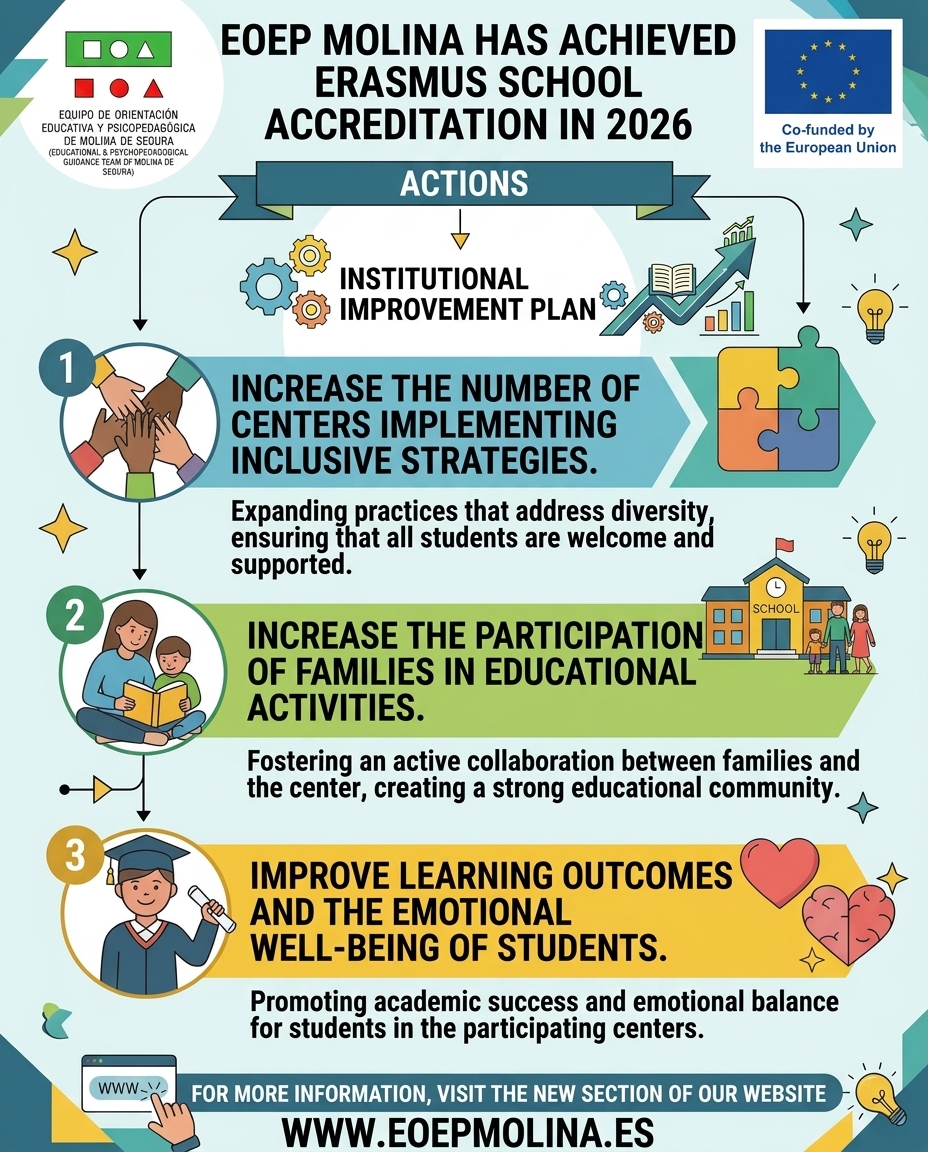
Click on the infographic to see it full size.
Our objectives
Three connected objectives that respond to the needs of the schools we work with. Open each section to see the details.
More inclusive practice in the classroom
Increase the number of teachers implementing inclusive methodologies and strategies.
What we aim to improve
- Advisory services to schools, increasing the uptake of inclusive methodologies: Universal Design for Learning (UDL), project-based learning, problem-based learning, gamification, diversification of materials and activities, multiple intelligences…
- Teacher satisfaction when facing learner diversity in the classroom, helping to reduce stress levels.
- Teacher commitment to embedding more inclusive teaching-learning processes on a stable basis and with progressively higher quality.
Timeline
- Year 1: our own training and analysis, agreed with school leadership teams, of how to implement these innovations. Collection, dissemination and feasibility analysis of materials and resources.
- Year 2: teacher training programme on inclusive strategies in at least 12 schools.
- Years 3 & 4: expansion of the programme to at least 18 schools.
- First results expected at the end of Year 2.
How we will evaluate it
- Baseline pre-test using the Aulainclusiva.es questionnaire on inclusive classroom strategies, together with the European Commission’s inclusion indicators (Structural Indicators for Inclusive Systems in and around Schools, 2017).
- Review of each school’s inclusion programme after every mobility.
- Feedback questionnaires after every workshop or training session (perceived usefulness, difficulties, number of participants).
- Termly questionnaire for teachers and headteachers on the new strategies in place, and a pre/post comparison at the end of each school year.
Families more involved in school
Increase participation in schools among families with fewer opportunities who traditionally do not engage in educational activities.
Why it matters
In our sector, 18% of students have fewer opportunities, and approximately 10% of families traditionally do not participate in educational activities. Greater family involvement is linked to better learning outcomes and helps prevent school failure, early school leaving and, consequently, social exclusion.
Among other family engagement strategies, we want to explore how Learning Communities (Comunidades de aprendizaje) work in different countries.
Timeline
- Training related to this objective will take place during the second year of the project.
- We will then design new groups and family workshops (e.g. on Learning Communities) in at least 12 schools for the most vulnerable families.
- First results expected at the end of Year 2.
How we will evaluate it
- Class teachers record the number of parents attending each school activity, with a graph tracking progress over the four years.
- Questionnaires on satisfaction, difficulties and needs for parents in our Family Support Groups.
- Questionnaire for school leadership teams on Learning Communities and other family participation initiatives.
- Interviews and close coordination with Social Services and Mental Health services for highly vulnerable families.
Better learning and well-being
Contribute to improving the learning outcomes of all students, particularly those with fewer opportunities.
What we will focus on
- Overall grade improvement.
- Student emotional well-being.
- Literacy and numeracy levels, basic skills that currently stand below the national average in our region.
This objective complements the other two: by improving teacher advisory services and family participation, we also contribute to better student outcomes.
Timeline
- Some aspects, such as emotional well-being, are expected to improve from the end of Year 1.
- Clear results in reading comprehension and mathematics are expected from Year 3 onwards.
How we will evaluate it
- Termly results for all grade levels, with dedicated tracking of students with special educational needs and those with fewer opportunities.
- Termly tables from class teachers on reading comprehension and mathematics grades.
- Well-being surveys for students (from Primary Grade 3), families and teachers.
The plan step by step
Year 1
- First training mobilities for our team.
- Analysis with school leadership teams of how to apply what we learn.
- Collection and dissemination of materials and resources.
Year 2
- Training on family participation and Learning Communities.
- Teacher training on inclusive strategies in at least 12 schools.
- New family workshops in at least 12 schools.
Years 3 & 4
- Training programme expanded to at least 18 schools.
- Clear results in reading comprehension and mathematics.
- Continuation subject to renewal after the 2021-2027 Erasmus+ programme.
Erasmus Quality Standards
Being an accredited organisation requires adherence to high quality standards. This is how we apply them in our plan:
Inclusion
We prioritise schools and families with fewer opportunities.
See measures
- Dedicated workshops for families with fewer opportunities, encouraging more Learning Communities.
- More and better professional development for teachers (UDL, project-based learning, gamification…).
- Materials tailored to parents, with visual cues and short videos, freely available on our website, on social media and on visual boards in each school.
- Diverse communication channels to reach families who traditionally interact less with the school.
- Priority for schools with a higher percentage of students with fewer opportunities.
Sustainability
Less paper, more digital resources and lower-footprint travel.
See measures
- Limit printing and use recycled paper when printing is necessary.
- Prioritise eco-friendly materials.
- Digital advisory resources (QR codes, presentations, infographics) openly available on our website.
- Greener transport for mobilities and, when flying is unavoidable, flights with the lowest carbon footprint, using the calculator in the SEPIE Communication Kit.
- Highlight the sustainability measure applied in every publication.
Digital education
Online training, eTwinning and digital dissemination of what we learn.
See measures
- More eTwinning projects in our schools, involving students with fewer opportunities with the support of learning support teachers.
- Priority for online training and for courses that enhance our staff’s digital competence.
- Sourcing courses and job-shadowing host centres through ESEP, EPALE and Euroguidance.
- Dissemination of new materials through this section of our website and social media, using the #ErasmusPlus hashtag.
Erasmus networks
We share and learn with schools across Europe.
See measures
- Maintain and expand our European Network of Best Practice Schools (see Changing schools, changing lives).
- Continue acting as a host institution for international staff who want to learn about our education system.
- More eTwinning projects with the support of SEN and Speech and Language specialists, focusing on maths challenges and reading comprehension.
- Remain open to hosting university students or recent graduates for Erasmus+ traineeships.

The EOEP Molina Erasmus Improvement Plan is co-funded by the Erasmus+ Programme of the European Union. Funded by the European Union. Views and opinions expressed are however those of the author(s) only and do not necessarily reflect those of the European Union or the Spanish Service for the Internationalisation of Education (SEPIE). Neither the European Union nor the granting authority can be held responsible for them.